25 November 2025
Elim joins faith leaders who oppose Bill to legalise assisted suicide
Mark Pugh, General Superintendent of Elim Pentecostal Churches, joins with major UK faith leaders to warn that a right to die could too easily end in vulnerable people feeling they have a duty to die.
Faith leaders have joined together to express serious concerns about the potential impact on vulnerable individuals if Parliament approves assisted suicide. In a letter published before the Second Reading of the Terminally Ill Adults (End of Life) Bill, they warn that a right to die might lead to vulnerable people feeling obligated to end their lives.
The letter, signed by 29 faith leaders including the Bishop of London, the Roman Catholic Cardinal Archbishop of Westminster, and the Chief Rabbi, advocates for investment in palliative care as the truly compassionate approach to end-of-life issues. This letter was featured in The Observer newspaper (Sunday 24 November 2024).
As leaders of faith communities we wish to express our concern at the Terminally Ill Adults (End of Life) bill, which will be debated by MPs on 29 November. We are aware of how complex and weighty this topic is. There are many dimensions to the bill, all of them of great ethical and practical importance. We hold in prayer all those across our country who may be personally affected, and our representatives in Parliament with profound decisions before them.
Part of the role of faith leaders in communities is to provide spiritual and pastoral care for the sick and for the dying. We hold the hands of loved ones in their final days, we pray with families both before and after death. It is to this vocation that we have been called, and it is from this vocation that we write.
Our pastoral roles make us deeply concerned about the impact the bill would have on the most vulnerable, opening up the possibility of life-threating abuse and coercion. This is a concern we know is shared by many people, with and without faith.
In the UK, it is estimated that 2.7 million older people have been subjected to abuse; many of these may also be vulnerable to pressure to end their lives prematurely. Disability campaigners and those working with women in abusive relationships have also highlighted the danger of unintended consequences should the law be changed. The experience of jurisdictions which have introduced similar legislation, such as Oregon and Canada, demonstrate how tragic these unintended consequences can be. Promised safeguards have not always protected the vulnerable and marginalised.
Even when surrounded by loving family and friends, people towards the end of their life can still feel like a burden. This is especially the case while adult social care remains underfunded. In this environment, it is easy to see how a ‘right to die’ could all too easily end in feeling you have a duty to die.
We are convinced that the current law provides much greater security for those who are vulnerable than the bill before Parliament. A bill which MPs will have had only three weeks to scrutinise before they vote on it. The most effective safeguard against life-threatening coercion or abuse is to keep the law as it is.
In supporting the state of the current law, we do not deny that some people experience a painful death, though we welcome the fact that these deaths are far less common than they used to be due to advances in palliative care.
Over decades we have witnessed how compassionate care, along with the natural processes of dying, allow those at the end of their life to experience important moments. We have seen relationships repair and families reconcile. We have seen lives end in love. Much can be lost by cutting these processes short.
We believe that a truly compassionate response to the end of life lies in the provision of high-quality palliative care services to all who need them. While there are many examples of excellent palliative care in this country, it remains worryingly underfunded. Investment in palliative care is the policy of a truly compassionate nation. It is the way to ensure that everyone in society, including the most vulnerable, receive the care they deserve at the end of life.
Dame Sarah Mullally, Bishop of London and former Chief Nursing Officer
Cardinal Vincent Nichols, Archbishop of Westminster
Sir Ephraim Mirvis, Chief Rabbi of the United Hebrew Congregations of the Commonwealth
Full list of signatories:
-
Sayed Abdul Saheb Al-Khoei, Secretary General of Al-Khoei Foundation
-
Angaelos, Archbishop of London, Coptic Orthodox Church
-
Qari Asim, Imam and Chair of MINAB (Mosques and Imams Advisory Board)
-
Glyn Barrett, National Leader of Assemblies of God
-
Anil Bhanot, Managing Trustee of the Hindu Council UK
-
Gavin Calver, CEO of Evangelical Alliance
-
Malcolm Deboo, President, Zoroastrian Trust Funds of Europe
-
Joseph Dweck, Senior Rabbi of the Spanish & Portuguese Sephardi Community
-
Pinchas Hackenbroch, Chair of the Rabbinical Council of the United Synagogue
-
Ross Hendry, CEO of CARE (Christian Action, Research and Education)
-
Trevor Howard, Executive Vice-Chair of the Board, Churches in Communities International
-
Andrew John, Archbishop of the Church in Wales
-
Nikitas Lulias, Archbishop of Great Britain, Greek Orthodox Church
-
Paul Main and Jenine Main, Territorial Leaders of The Salvation Army in the United Kingdom and Ireland
-
Patrick McKinney, Bishop of Nottingham, Roman Catholic Church
-
Zara Mohammed, Secretary General of the Muslim Council of Britain
-
Bhai Sahib Mohinder Singh Ahluwalia, Spiritual Leader & Chair, Guru Nanak Nishkam Sewak Jatha
-
Trupti Patel, President of the Hindu Forum of Britain
-
Mark Pugh, General Superintendent of Elim Pentecostal Churches
-
Mehool Sanghrajka, Chair of the Institute of Jainology
-
Bogoda Seelawimala, President of Sri Lankan Sangha Sabha of GB
-
Lord Singh of Wimbledon, Director of the Network of Sikh Organisations UK
-
Jonathan Wittenberg, Senior Rabbi of Masorti Judaism
-
Mar Awraham Youkhanis, Bishop of London, Assyrian Church of the East.
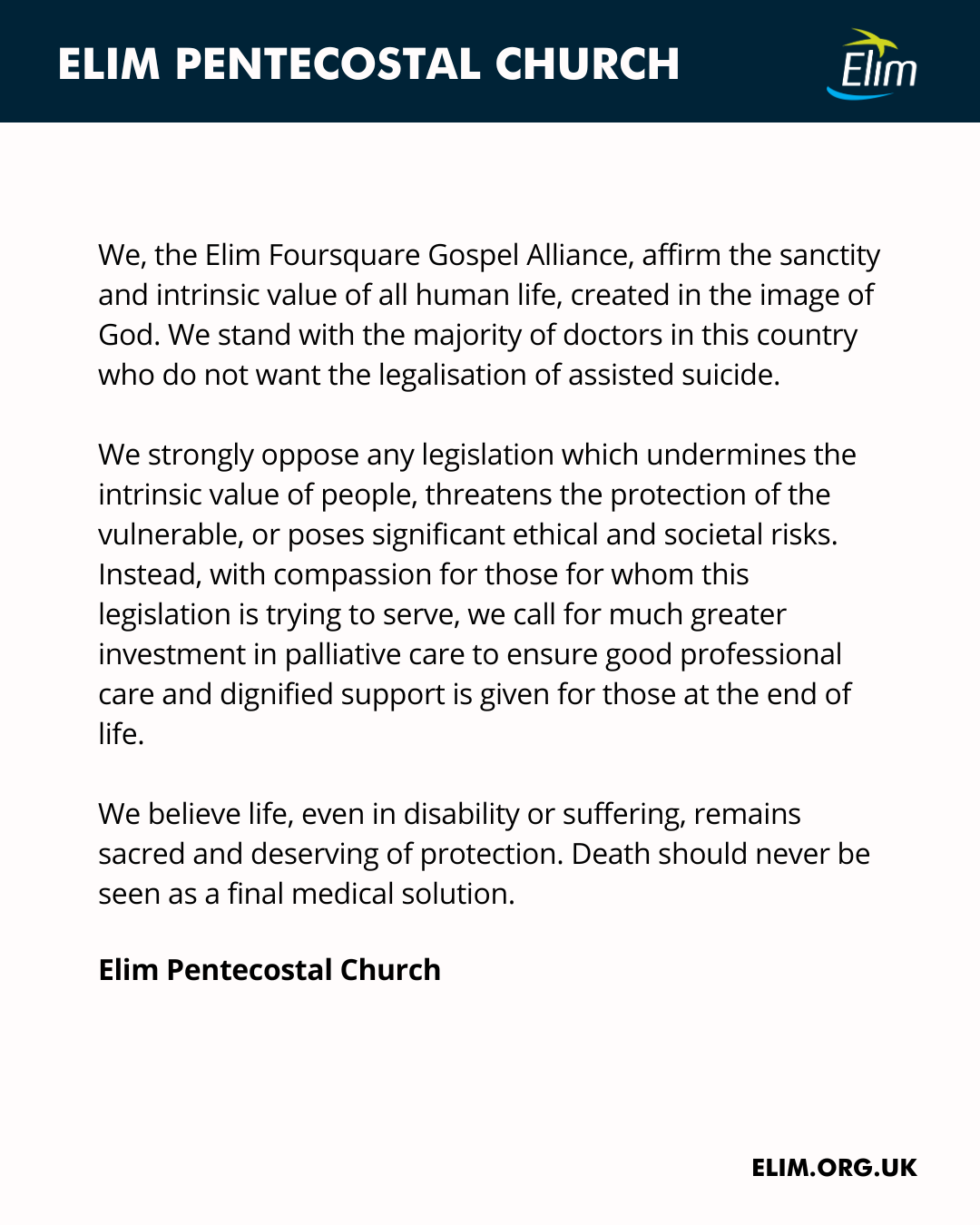
In addition, Elim published the following statement on 20 November 2024.